Back in the US: How Family Reacted to Alex’s Moroccan Stories
Morocco travel stories in Alex’s travel notes: a personal story, practical lesson and positive travel perspective from Morocco.




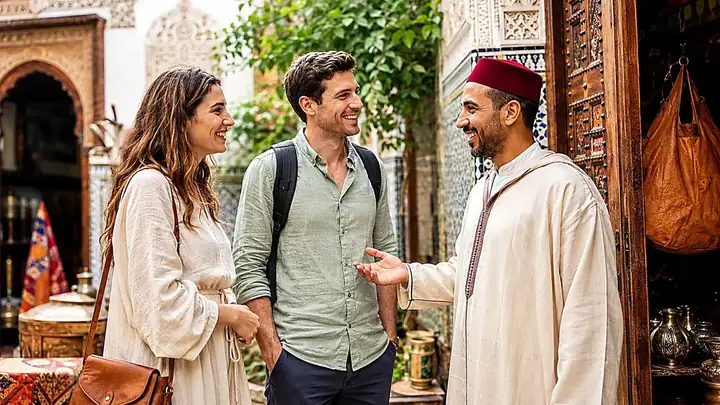
Back home, the stories Alex told were not about danger or difficulty. They were about hospitality, food, humor, landscapes and how different reality felt from the warnings.
Before Morocco travel stories, I was still trying to make Morocco fit a traveler’s timetable and I worried too much about saying things perfectly. The real moment was simpler: Back home, the stories Alex told were not about danger or difficulty. They were about hospitality, food, humor, landscapes and how different reality felt from the warnings.
Youssef brought the lesson back to real Moroccan life: The best answer to stereotypes is often a specific story about what actually happened. He reminded me that Darija works best as a small sign of respect, not as a performance.
Around Morocco travel stories, the pattern I kept hearing was short, warm Darija used naturally in the situation. A greeting, a thank-you and a simple practical phrase often opened the interaction better than a long formal sentence.
The best answer to stereotypes is often a specific story about what actually happened.
Morocco travel stories is the phrase I use for this chapter of my travel notes. I wrote this note because the experience changed a small assumption I had been carrying for years. Back home, the stories Alex told were not about danger or difficulty. They were about hospitality, food, humor, landscapes and how different reality felt from the warnings. What stayed with me was not a perfect itinerary but the moment when an unfamiliar place became specific, human and easier to read.
The headline of this story is Back in the US: How Family Reacted to Alex’s Moroccan Stories, but the useful part sits underneath the headline. I was learning how to travel through Morocco without reducing it to a stereotype, and I was discovering that preparation works best when it leaves room for people to surprise you.
I came away from the experience with a warmer view of Morocco and a more practical definition of confidence. Morocco felt more generous and more layered each day because the trip moved beyond monuments into repeated human encounters. That is the kind of change I want these travel notes to document. I would carry the same lesson forward without assuming another traveler will have the same interaction.

The real moment behind Morocco travel stories
I can trace Morocco travel stories back to a particular change in attention. Back home, the stories Alex told were not about danger or difficulty. They were about hospitality, food, humor, landscapes and how different reality felt from the warnings. Afterward I understood something I had missed before: the best answer to stereotypes is often a specific story about what actually happened.
The atmosphere around that moment mattered. I was paying attention to ochre walls, tiled courtyards, market lanes, mint tea, mountain roads and the changing rhythm between city and village. None of those details was important because it looked exotic; they mattered because they helped me understand the pace of the place and how I should move through it. In my notebook, that point sits beside the line: The best answer to stereotypes is often a specific story about what actually happened.
What I remember most is the warmth of ordinary Moroccan interactions, where a greeting or a few minutes of conversation often mattered more than perfect planning. That human scale is what made Morocco travel stories worth writing down. It shifted the story away from what I had been told to expect and toward what was actually happening in front of me.
What Morocco travel stories changed once I stopped comparing
The useful shift was from prediction to observation: look, listen, ask, then decide. In the case of Morocco travel stories, that meant letting the scene be itself instead of constantly translating it back into an American or European reference point. The more I did that, the less energy I spent deciding whether something was ‘normal’ and the more I noticed why it made sense locally.
There was also a relief in not having to understand everything immediately. Back home, the stories Alex told were not about danger or difficulty. They were about hospitality, food, humor, landscapes and how different reality felt from the warnings. I could enjoy the moment, ask one useful question, learn one phrase and carry on. That felt far more natural than treating travel as an exam on which every cultural cue had a right answer.
The positive memory is not based on pretending that every minute was effortless. It is positive because small uncertainties repeatedly turned into conversations, directions, jokes, food recommendations or patient explanations. That pattern changed how I thought about Morocco. That was especially clear in the experience behind “Back in the US: How Family Reacted to Alex’s Moroccan Stories.”
What a photograph misses about Morocco travel stories
A photograph can show the setting of back in the us: how family reacted to alex’s moroccan stories, but it cannot show the few seconds before a stranger decides to help, the tone of a greeting, or the relief of realizing that a mistake has not ruined the interaction. Those are the pieces that made the memory feel generous.
I began noticing how much travel depends on tiny acts of cooperation. Someone points, repeats, waits, laughs with you rather than at you, or makes room for a question. Around Morocco travel stories, those acts mattered more than whether I had chosen the perfect route through the day.
That is why I describe this as a travel note rather than a definitive guide to a culture. The note records one encounter and the shift it produced in me. It invites another traveler to arrive curious, not to assume that the same people owe them the same experience. The memory gave the principle a human scale, which is why it survived after the itinerary itself faded. In this chapter, I connect that principle specifically to “Back in the US: How Family Reacted to Alex’s Moroccan Stories.”

What I misunderstood before Morocco travel stories
Before this chapter of the trip, I still carried the beginner’s habit of turning uncertainty into a prediction. If I did not know how a taxi, meal, greeting or social custom would work, my mind filled the gap with whatever image was most familiar. Real travel corrected that habit quickly. In this story, that point is grounded in one specific memory: Back home, the stories Alex told were not about danger or difficulty. They were about hospitality, food, humor, landscapes and how different reality felt from the warnings.
The better approach was to make the question smaller. Instead of asking whether I understood Morocco, I could ask what this person meant, how this neighborhood worked, what this phrase sounded like, or what I needed for the next hour. Specific questions produced useful answers. The practical note I attached to it was equally specific: The best answer to stereotypes is often a specific story about what actually happened.
The lesson I wrote beside this story was: The best answer to stereotypes is often a specific story about what actually happened. I still like that sentence because it does not demand fearlessness or expertise. It asks for attention, preparation and enough humility to update an assumption.
The local perspective that sharpened the note
Youssef’s role in this memory was not to turn me into a Moroccan speaker overnight. He helped me hear what was too formal, what sounded warm, and when a simple greeting did more work than a long sentence. That local calibration changed how I understood this part of the journey.
That distinction is central to EasyArabicNow. I am writing from a traveler’s point of view; local review matters because a visitor can remember a feeling accurately and still misunderstand a phrase, custom or nuance. Around this travel moment, the local perspective turns a personal memory into something more useful for the next traveler. That is one reason the chapter “Back in the US: How Family Reacted to Alex’s Moroccan Stories” stayed in my notebook after the trip.
I also learned not to use one local friend as a spokesperson for an entire country. The value of Youssef’s Moroccan perspective is precision about language and context, not permission to flatten millions of people into one opinion. The more specific the note becomes, the more respectful it feels. Here, the idea only made sense after the trip gave it a concrete setting: Back home, the stories Alex told were not about danger or difficulty. They were about hospitality, food, humor, landscapes and how different reality felt from the warnings.
What this story taught me about useful Arabic
The language lesson was surprisingly consistent: I needed less Arabic than I imagined, but I needed the right Arabic at the right moment. For this part of the journey, I cared about Darija for taxis, riads, cafés, souks, directions and friendly everyday exchanges. That is where a short phrase can change the temperature of an interaction. My own takeaway was not theoretical; I wrote down this rule for the next trip: The best answer to stereotypes is often a specific story about what actually happened.
I stopped measuring success by how long a sentence I could produce. A greeting said naturally, a phrase shown clearly on a phone, or a simple question understood on the first try was more valuable than a formal sentence I had to perform from memory. that day reinforced that rule. I remember this principle through the details of “Back in the US: How Family Reacted to Alex’s Moroccan Stories,” not as a general slogan about travel.
This is why the cards are designed around situations rather than grammar chapters. The goal is not to pretend a traveler has learned Moroccan Darija in a weekend. The goal is to make the next taxi, hotel desk, café, market or request for help easier and more respectful. The scene that made that lesson real was simple to describe later: Back home, the stories Alex told were not about danger or difficulty. They were about hospitality, food, humor, landscapes and how different reality felt from the warnings.

What I would tell an American planning the same kind of trip
For an American traveler, the biggest preparation mistake is often trying to solve the whole cultural difference before departure. I would prepare the essentials, then leave enough mental space for that memory to teach me something on location. You cannot pre-read every human interaction. For me, the useful version of that idea became: The best answer to stereotypes is often a specific story about what actually happened.
I would also separate unfamiliarity from risk. A different soundscape, dress code, meal rhythm or style of conversation may feel intense without being dangerous. At the same time, a warm personal memory is never a substitute for current official information. That balance kept my enthusiasm for Morocco grounded rather than naive. That distinction matters in “Back in the US: How Family Reacted to Alex’s Moroccan Stories” because the story depends on a real change in my own expectations.
Finally, I would learn a few respectful phrases before chasing vocabulary volume. The first useful words create a bridge; after that, people can often help you with the next word. That small rhythm of attempt, correction and gratitude is one of the best parts of travel. I kept it in the notes because it helped me interpret the next day with more patience and less assumption. In this chapter, I connect that principle specifically to “Back in the US: How Family Reacted to Alex’s Moroccan Stories.”
- Save the practical details connected to the experience offline before you need them.
- Carry more than one payment option and keep your arrival address easy to show.
- Learn a greeting and a thank-you in Moroccan Darija without worrying about perfect performance.
- Check current entry, transport and safety information close to departure.
- Leave open time for conversations, food and discoveries that were not on the original schedule.
How I would plan the day differently now
If I repeated the day behind this chapter of the trip, I would make the plan shorter. I would lock in the few things that can genuinely derail a trip—documents, arrival, connectivity, a safe way back, and any timed reservation—then stop optimizing every minute. The chapter-specific context matters: Back home, the stories Alex told were not about danger or difficulty. They were about hospitality, food, humor, landscapes and how different reality felt from the warnings.
I would keep one note on my phone with the address, the relevant phrase, a screenshot of the route and the name of the place written clearly. That is not glamorous travel advice, but it creates the confidence to look up from the screen and actually notice ochre walls, tiled courtyards, market lanes, mint tea, mountain roads and the changing rhythm between city and village. I would carry the same lesson forward without assuming another traveler will have the same interaction.
I would also spend less effort trying to prove that I was independent. Asking for help is not a travel failure. In many of my best memories, the request itself opened the conversation that I later remembered more clearly than the attraction I was trying to reach. In my notebook, that point sits beside the line: The best answer to stereotypes is often a specific story about what actually happened.
Why the experience made the Arab world feel closer
I left with a longer list of people, foods, neighborhoods and phrases I wanted to understand next time. this part of the journey played a part in that shift because it gave me a specific memory to place where a vague idea had been. Specific memories are harder for stereotypes to survive. That was especially clear in the experience behind “Back in the US: How Family Reacted to Alex’s Moroccan Stories.”
That is especially true when the memory is ordinary. Sharing tea, figuring out a fare, ordering food, asking a shopkeeper a question, listening to a family story or learning how to pronounce one word correctly can do more to humanize a destination than a dramatic itinerary ever could. The memory gave the principle a human scale, which is why it survived after the itinerary itself faded. In this chapter, I connect that principle specifically to “Back in the US: How Family Reacted to Alex’s Moroccan Stories.”
My view of Morocco became more positive through accumulation. One helpful interaction did not prove a theory; dozens of small interactions simply made the region feel less abstract. That is a quieter kind of transformation, and it is the one I trust most. In this story, that point is grounded in one specific memory: Back home, the stories Alex told were not about danger or difficulty. They were about hospitality, food, humor, landscapes and how different reality felt from the warnings.

The note I carried into the next trip
My notebook line after this story was not complicated: The best answer to stereotypes is often a specific story about what actually happened. I carried it forward because it works beyond one city or one country. It keeps preparation useful without allowing preparation to become a wall between traveler and place.
I also carried forward a new rule for language: save what you actually used. If a phrase helped, I wrote it down. If a local person corrected it, I changed the note. If it sounded too formal for the situation, that mattered. Over time, those small corrections became the logic behind EasyArabicNow. The practical note I attached to it was equally specific: The best answer to stereotypes is often a specific story about what actually happened.
That is the connection between this story and the cards. that day is not included because every traveler will reproduce my experience. It is included because the experience exposed a recurring travel need and showed what kind of language or preparation made that need easier to handle. That is one reason the chapter “Back in the US: How Family Reacted to Alex’s Moroccan Stories” stayed in my notebook after the trip.
A practical language layer for this story
Before a similar day, I would browse the free offline Arabic cards and keep only the situations connected to my route. I would also read the destination encyclopedia for context, then use Alex’s Travel Notes for the human layer behind the practical advice. Here, the idea only made sense after the trip gave it a concrete setting: Back home, the stories Alex told were not about danger or difficulty. They were about hospitality, food, humor, landscapes and how different reality felt from the warnings.
For this travel lesson, the most useful preparation is not a long lesson the night before. It is a small toolkit: the address, the local phrase, the pronunciation, the offline map, and enough context to know when the phrase is appropriate. That is what ‘Your Offline Arabic Cards’ is meant to deliver. My own takeaway was not theoretical; I wrote down this rule for the next trip: The best answer to stereotypes is often a specific story about what actually happened.
A current-information note before you go
My memories around that memory are positive, but they are memories, not a safety guarantee or a substitute for current rules. Travel conditions can change by country, route and date. I recheck entry requirements, transport conditions and official guidance before departure even when I know a destination well. I remember this principle through the details of “Back in the US: How Family Reacted to Alex’s Moroccan Stories,” not as a general slogan about travel.
For current official information, I use the U.S. State Department international travel pages alongside the destination’s own immigration, tourism, health and transport sources. That keeps the personal story honest: the memory can stay warm while the practical advice stays current. The scene that made that lesson real was simple to describe later: Back home, the stories Alex told were not about danger or difficulty. They were about hospitality, food, humor, landscapes and how different reality felt from the warnings.
Frequently asked questions
Did the experience feel comfortable immediately?
Not completely. The interesting part was watching uncertainty turn into familiarity through specific interactions. I did not need the whole day to feel familiar before I could enjoy it; I needed enough preparation to stay present and enough humility to ask when I was unsure. For me, the useful version of that idea became: The best answer to stereotypes is often a specific story about what actually happened.
Did this chapter of the trip change my view of Morocco?
Yes, but not because one moment can explain an entire place. It changed my view by replacing an inherited generalization with a specific memory involving real people, a real setting and a practical lesson I could carry into the next day. That distinction matters in “Back in the US: How Family Reacted to Alex’s Moroccan Stories” because the story depends on a real change in my own expectations.
Would I recommend this kind of experience to a first-time visitor?
I would recommend researching it and adapting it to your own route, comfort level and current conditions. The reason I remember this part of the journey positively is not that I copied somebody else’s perfect itinerary; it is that I arrived prepared enough to participate and flexible enough to learn. I kept it in the notes because it helped me interpret the next day with more patience and less assumption. In this chapter, I connect that principle specifically to “Back in the US: How Family Reacted to Alex’s Moroccan Stories.”
What should I prepare before I go?
Start with documents, arrival logistics, connectivity, money, insurance or health needs, and current official guidance. Then add the human layer: a few words of Moroccan Darija, cultural context, and time that is not already claimed by reservations. The chapter-specific context matters: Back home, the stories Alex told were not about danger or difficulty. They were about hospitality, food, humor, landscapes and how different reality felt from the warnings.
Morocco travel stories is the specific phrase I use to index this note because it names the traveler’s question behind the story without turning the experience into a broad claim. In this chapter, I connect that principle specifically to “Back in the US: How Family Reacted to Alex’s Moroccan Stories.”
Why this travel moment still matters to me
this story still matters because it captures the point at which travel stopped being a collection of imagined risks and postcard images and became a relationship with specific places. I came away more interested in people, language and daily rhythm than in proving I had visited a famous destination. I would carry the same lesson forward without assuming another traveler will have the same interaction. In this chapter, I connect that principle specifically to “Back in the US: How Family Reacted to Alex’s Moroccan Stories.”
The experience also explains why EasyArabicNow is not built as a traditional language course. The useful Arabic in my notes was always attached to a moment: greet, order, ask, confirm, thank, explain, find, or show. That is a traveler’s problem, and the cards are designed as a traveler’s tool. In my notebook, that point sits beside the line: The best answer to stereotypes is often a specific story about what actually happened.
Most of all, back in the us: how family reacted to alex’s moroccan stories reminds me why I kept returning to the Arab world. The trips became richer as the region became less mysterious and more specific—different countries, different dialects, different histories, and a recurring experience of people making room for a visitor who was willing to listen.
If I could send one sentence back to myself before this chapter began, it would be the same one I keep beside the note today: The best answer to stereotypes is often a specific story about what actually happened. That is the part of the story I would want another traveler to carry forward.

A traveler’s note, locally reviewed where dialect matters.
EasyArabicNow Travel Notes connect a real travel moment to the local correction and the card that came out of the lesson. Time-sensitive rules, schedules, prices and health guidance should still be checked with official sources before travel.